Trace Space Back to You!
Have you ever wondered how space exploration impacts your daily life?
Space exploration has created new markets and new technologies that have spurred our economy and changed our lives in many ways. This year, NASA unveiled two new complementary interactive Web features, NASA City and NASA @ Home, available at
www.nasa.gov/city. The new features highlight how space pervades our lives, invisible yet critical to so many aspects of our daily activities and well-being.
Health and Medicine
Light-Emitting Diodes (LEDs)
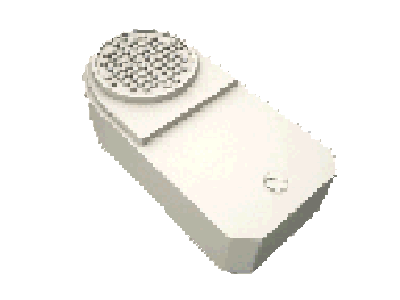 |
Red light-emitting diodes are growing plants in space and healing humans on Earth. The LED technology used in NASA space shuttle plant growth experiments has contributed to the development of medical devices such as award-winning WARP 10, a hand-held, high-intensity, LED unit developed by Quantum Devices Inc. The WARP 10 is intended for the temporary relief of minor muscle and joint pain, arthritis, stiffness, and muscle spasms, and also promotes muscle relaxation and increases local blood circulation. The WARP 10 is being used by the U.S. Department of Defense and U.S. Navy as a noninvasive “soldier self-care” device that aids front-line forces with first aid for minor injuries and pain, thereby improving endurance in combat. The next-generation WARP 75 has been used to relieve pain in bone marrow transplant patients, and will be used to combat the symptoms of bone atrophy, multiple sclerosis, diabetic complications, Parkinson’s disease, and in a variety of ocular applications. (Spinoff 2005, 2008)
Infrared Ear Thermometers
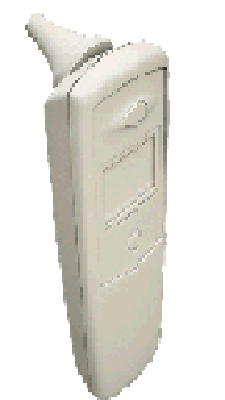
Diatek Corporation and NASA developed an aural thermometer, which weighs only 8 ounces and uses infrared astronomy technology to measure the amount of energy emitted by the eardrum, the same way the temperature of stars and planets is measured. This method avoids contact with mucous membranes, virtually eliminating the possibility of cross infection, and permits rapid temperature measurement of newborn, critically-ill, or incapacitated patients. NASA supported the Diatek Corporation, a world leader in electronic thermometry, through the Technology Affiliates Program. (Spinoff 1991)
Artificial Limbs
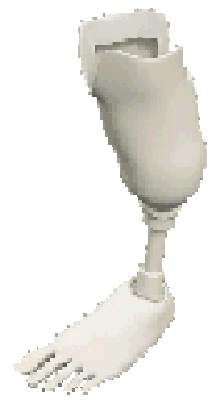
NASA’s continued funding, coupled with its collective innovations in robotics and shock-absorption/comfort materials are inspiring and enabling the private sector to create new and better solutions for animal and human prostheses. Advancements such as Environmental Robots Inc.’s development of artificial muscle systems with robotic sensing and actuation capabilities for use in NASA space robotic and extravehicular activities are being adapted to create more functionally dynamic artificial limbs (Spinoff 2004). Additionally, other private-sector adaptations of NASA’s temper foam technology have brought about custom-moldable materials offering the natural look and feel of flesh, as well as preventing friction between the skin and the prosthesis, and heat/moisture buildup. (Spinoff 2005)
Ventricular Assist Device
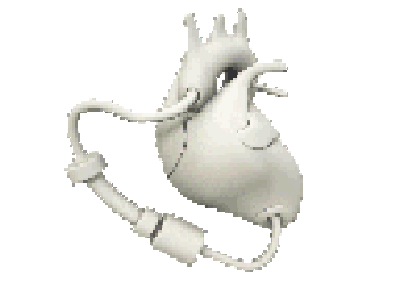
Collaboration between NASA, Dr. Michael DeBakey, Dr. George Noon, and MicroMed Technology Inc. resulted in a lifesaving heart pump for patients awaiting heart transplants. The MicroMed DeBakey ventricular assist device (VAD) functions as a “bridge to heart transplant” by pumping blood throughout the body to keep critically ill patients alive until a donor heart is available. Weighing less than 4 ounces and measuring 1 by 3 inches, the pump is approximately one-tenth the size of other currently marketed pulsatile VADs. This makes it less invasive and ideal for smaller adults and children. Because of the pump’s small size, less than 5 percent of the patients implanted developed device-related infections. It can operate up to 8 hours on batteries, giving patients the mobility to do normal, everyday activities. (Spinoff 2002)
Transportation
Anti-Icing Systems
NASA funding under the Small Business Innovation Research (SBIR) program and work with NASA scientists advanced the development of the certification and integration of a thermoelectric deicing system called Thermawing, a DC-powered air conditioner for single-engine aircraft called Thermacool, and high-output alternators to run them both. Thermawing, a reliable anti-icing and deicing system, allows pilots to safely fly through ice encounters and provides pilots of single-engine aircraft the heated wing technology usually reserved for larger, jet-powered craft. Thermacool, an innovative electric air conditioning system, uses a new compressor whose rotary pump design runs off an energy-efficient, brushless DC motor and allows pilots to use the air conditioner before the engine even starts. (Spinoff 2007)
Highway Safety
Safety grooving, the cutting of grooves in concrete to increase traction and prevent injury, was first developed to reduce aircraft accidents on wet runways. Represented by the International Grooving and Grinding Association, the industry expanded into highway and pedestrian applications. The technique originated at Langley Research Center, which assisted in testing the grooving at airports and on highways. Skidding was reduced, stopping distance decreased, and a vehicle’s cornering ability on curves was increased. The process has been extended to animal holding pens, steps, parking lots, and other potentially slippery surfaces. (Spinoff 1985)
Improved Radial Tires
Goodyear Tire and Rubber Company developed a fibrous material, five times stronger than steel, for NASA to use in parachute shrouds to soft-land the Vikings on the Martian surface. The fiber’s chain-like molecular structure gave it incredible strength in proportion to its weight. Recognizing the increased strength and durability of the material, Goodyear expanded the technology and went on to produce a new radial tire with a tread life expected to be 10,000 miles greater than conventional radials. (Spinoff 1976)
Chemical Detection
 |
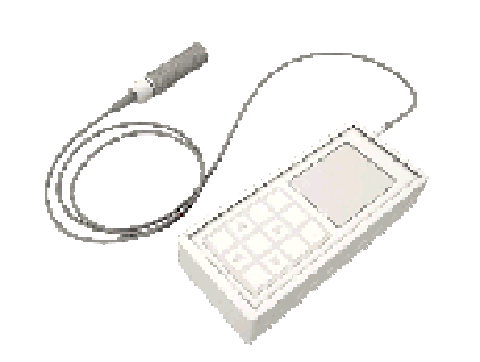
NASA contracted with Intelligent Optical Systems (IOS) to develop moisture- and pH-sensitive sensors to warn of potentially dangerous corrosive conditions in aircraft before significant structural damage occurs. This new type of sensor, using a specially manufactured optical fiber whose entire length is chemically sensitive, changes color in response to contact with its target. After completing the work with NASA, IOS was tasked by the U.S. Department of Defense to further develop the sensors for detecting chemical warfare agents and potential threats, such as toxic industrial compounds and nerve agents, for which they proved just as successful. IOS has additionally sold the chemically sensitive fiber optic cables to major automotive and aerospace companies, who are finding a variety of uses for the devices such as aiding experimentation with nontraditional power sources, and as an economical “alarm system” for detecting chemical release in large facilities. (Spinoff 2007)
Public Safety
Video Enhancing and Analysis Systems
Intergraph Government Solutions developed its Video Analyst System (VAS) by building on Video Image Stabilization and Registration (VISAR) technology created by NASA to help FBI agents analyze video footage. Originally used for enhancing video images from nighttime videotapes made with hand-held camcorders, VAS is a state-of-the-art, simple, effective, and affordable tool for video enhancement and analysis offering benefits such as support of full-resolution digital video, stabilization, frame-by-frame analysis, conversion of analog video to digital storage formats, and increased visibility of filmed subjects without altering underlying footage. Aside from law enforcement and security applications, VAS has also been adapted to serve the military for reconnaissance, weapons deployment, damage assessment, training, and mission debriefing. (Spinoff 2001)
Land Mine Removal
Due to arrangements such as the one between Thiokol Propulsion and NASA that permits Thiokol to use NASA’s surplus rocket fuel to produce a flare that can safely destroy land mines, NASA is able to reduce propellant waste without negatively impacting the environment, and Thiokol is able to access the materials needed to develop the Demining Device flare. The Demining Device flare uses a battery-triggered electric match to ignite and neutralize land mines in the field without detonation. The flare uses solid rocket fuel to burn a hole in the mine’s case and burn away the explosive contents so the mine can be disarmed without hazard. (Spinoff 2000)
Fire-Resistant Reinforcement
Built and designed by Avco Corporation, the Apollo heat shield was coated with a material whose purpose was to burn and thus dissipate energy during reentry while charring, to form a protective coating to block heat penetration. NASA subsequently funded Avco’s development of other applications of the heat shield, such as fire-retardant paints and foams for aircraft, which led to the world’s first intumescent epoxy material, which expands in volume when exposed to heat or flames, acting as an insulating barrier and dissipating heat through burn-off. Further innovations based on this product include steel coatings devised to make high-rise buildings and public structures safer by swelling to provide a tough and stable insulating layer over the steel for up to 4 hours of fire protection, ultimately to slow building collapse and provide more time for escape. (Spinoff 2006)
Firefighter Gear
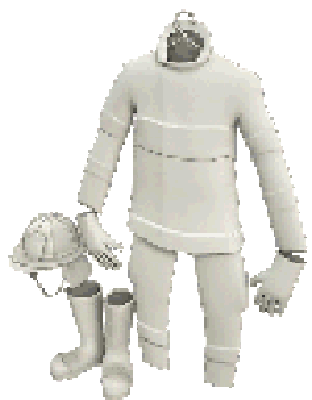 |
Firefighting equipment widely used throughout the United States is based on a NASA development that coupled Agency design expertise with lightweight materials developed for the U.S. Space Program. A project that linked NASA and the National Bureau of Standards resulted in a lightweight breathing system including face mask, frame, harness, and air bottle, using an aluminum composite material developed by NASA for use on rocket casings. Aerospace technology has been beneficially transferred to civil-use applications for years, but perhaps the broadest fire-related technology transfer is the breathing apparatus worn by firefighters for protection from smoke inhalation injury. Additionally, radio communications are essential during a fire to coordinate hose lines, rescue victims, and otherwise increase efficiency and safety. NASA’s inductorless electronic circuit technology contributed to the development of a lower-cost, more rugged, short-range two-way radio now used by firefighters. NASA also helped develop a specialized mask weighing less than 3 ounces to protect the physically impaired from injuries to the face and head, as well as flexible, heat-resistant materials—developed to protect the space shuttle on reentry—which are being used both by the military and commercially in suits for municipal and aircraft-rescue firefighters. (Spinoff 1976)
Consumer, Home, and Recreation
Temper Foam
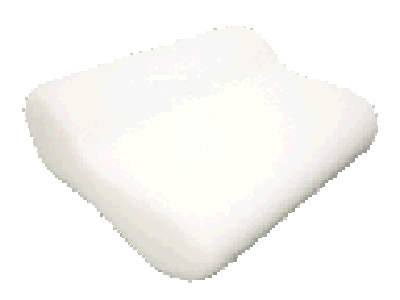
As the result of a program designed to develop a padding concept to improve crash protection for airplane passengers, Ames Research Center developed a foam material with unusual properties. The material is widely used and commonly known as temper foam or “memory foam.” The material has been incorporated into a host of widely used and recognized products including mattresses, pillows, military and civilian aircraft, automobiles and motorcycles, sports safety equipment, amusement park rides and arenas, horseback saddles, archery targets, furniture, and human and animal prostheses. Its high-energy absorption and soft characteristics not only offer superior protection in the event of an accident or impact, but enhanced comfort and support for passengers on long flights or those seeking restful sleep. Today, temper foam is being employed by NASCAR to provide added safety in racecars. (Spinoff 1976, 1977, 1979, 1988, 1995, 2002, 2005)
Enriched Baby Food
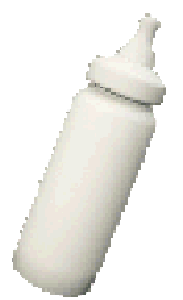
Commercially available infant formulas now contain a nutritional enrichment ingredient that traces its existence to NASA-sponsored research that explored the potential of algae as a recycling agent for long-duration space travel. The substance, formulated into the products life’sDHA and life’sARA, can be found in over 90 percent of the infant formulas sold in the United States, and are added to the infant formulas sold in over 65 additional countries. The products were developed and are manufactured by Martek Biosciences Corporation, which has pioneered the commercial development of products based on microalgae; the company’s founders and principal scientists acquired their expertise in this area while working on the NASA program. (Spinoff 1996, 2008)
Portable Cordless Vacuums
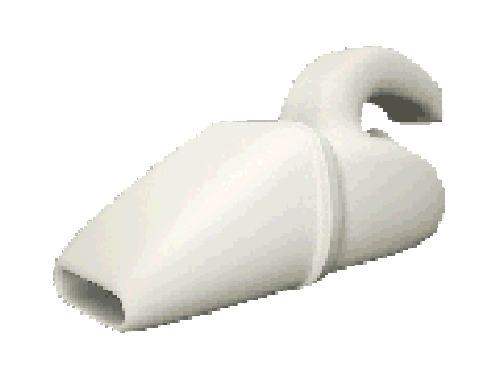
Apollo and Gemini space mission technologies created by Black & Decker have helped change the way we clean around the house. For the Apollo space mission, NASA required a portable, self-contained drill capable of extracting core samples from below the lunar surface. Black & Decker was tasked with the job, and developed a computer program to optimize the design of the drill’s motor and insure minimal power consumption. That computer program led to the development of a cordless miniature vacuum cleaner called the Dustbuster. (Spinoff 1981)
Freeze Drying Technology
In planning for the long-duration Apollo missions, NASA conducted extensive research into space food. One of the techniques developed was freeze drying—Action Products commercialized this technique, concentrating on snack food. The foods are cooked, quickly frozen, and then slowly heated in a vacuum chamber to remove the ice crystals formed by the freezing process. The final product retains 98 percent of its nutrition and weighs only 20 percent of its original weight. Today, one of the benefits of this advancement in food preparation includes simple nutritious meals available to handicapped and otherwise homebound senior adults unable to take advantage of existing meal programs sponsored by government and private organizations. (Spinoff 1976, 1994)
Environmental and Agricultural Resources
Harnessing Solar Energy
Homes across the country are now being outfitted with modern, high-performance, low-cost, single crystal silicon solar power cells that allow them to reduce their traditional energy expenditures and contribute to pollution reduction. The advanced technology behind these solar devices—which are competitively-priced and provide up to 50 percent more power than conventional solar cells—originated with the efforts of a NASA-sponsored 28-member coalition of companies, government groups, universities, and nonprofits forming the Environmental Research Aircraft and Sensor Technology (ERAST) Alliance. ERAST’s goal was to foster the development of remotely piloted aircraft intended to fly unmanned at high altitudes for days at a time, requiring advanced solar power sources that did not add weight. As a result, SunPower Corporation created the most advanced silicon-based cells available for terrestrial or airborne applications. (Spinoff2005)
Pollution Remediation
A product using NASA’s microencapsulating technology is available to consumers and industry enabling them to safely and permanently clean petroleum-based pollutants from water. The microencapsulated wonder, Petroleum Remediation Product or “PRP,” has revolutionized the way oil spills are cleaned. The basic technology behind PRP is thousands of microcapsules—tiny balls of beeswax with hollow centers. Water cannot penetrate the microcapsule’s cell, but oil is absorbed right into the beeswax spheres as they float on the water’s surface. Contaminating chemical compounds that originally come from crude oil (such as fuels, motor oils, or petroleum hydrocarbons) are caught before they settle, limiting damage to ocean beds. (Spinoff 1994, 2006)
Water Purification
NASA engineers are collaborating with qualified companies to develop a complex system of devices intended to sustain the astronauts living on the International Space Station and, in the future, those who go on to explore the Moon. This system, tentatively scheduled for launch in 2008, will make use of available resources by turning wastewater from respiration, sweat, and urine into drinkable water. Commercially, this system is benefiting people all over the world who need affordable, clean water. By combining the benefits of chemical adsorption, ion exchange, and ultra-filtration processes, products using this technology yield safe, drinkable water from the most challenging sources, such as in underdeveloped regions where well water may be heavily contaminated. (Spinoff 1995, 2006)
Computer Technology
Better Software
From real-time weather visualization and forecasting, high-resolution 3-D maps of the Moon and Mars, to real-time tracking of the International Space Station and the space shuttle, NASA is collaborating with Google Inc. to solve a variety of challenging technical problems ranging from large-scale data management and massively distributed computing, to human-computer interfaces—with the ultimate goal of making the vast, scattered ocean of data more accessible and usable. With companies like InterSense, NASA continues to fund and collaborate on other software advancement initiatives benefiting such areas as photo/video image enhancement, virtual-reality/design, simulation training, and medical applications. (Spinoff 2005)
Structural Analysis
 |
NASA software engineers have created thousands of computer programs over the decades equipped to design, test, and analyze stress, vibration, and acoustical properties of a broad assortment of aerospace parts and structures (before prototyping even begins). The NASA Structural Analysis Program, or NASTRAN, is considered one of the most successful and widely-used NASA software programs. It has been used to design everything from Cadillacs to roller coaster rides. Originally created for spacecraft design, NASTRAN has been employed in a host of non-aerospace applications and is available to industry through NASA’s Computer Software Management and Information Center (COSMIC). COSMIC maintains a library of computer programs from NASA and other government agencies and offers them for sale at a fraction of the cost of developing a new program, benefiting companies around the world seeking to solve the largest, most difficult engineering problems. (Spinoff 1976, 1977, 1978, 1979, 1980, 1981, 1982, 1986, 1988, 1990, 1991, 1998)
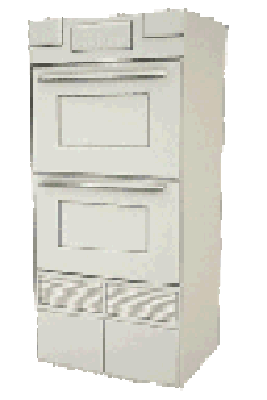
Refrigerated Internet-Connected Wall Ovens
Embedded Web Technology (EWT) software—originally developed by NASA for use by astronauts operating experiments on available laptops from anywhere on the International Space Station—lets a user monitor and/or control a device remotely over the Internet. NASA supplied this technology and guidance to TMIO LLC, who went on to develop a low-cost, real-time remote control and monitoring of a new intelligent oven product named “ConnectIo.” With combined cooling and heating capabilities, ConnectIo provides the convenience of being able to store cold food where it will remain properly refrigerated until a customized pre-programmable cooking cycle begins. The menu allows the user to simply enter the dinner time, and the oven automatically switches from refrigeration to the cooking cycle, so that the meal will be ready as the family arrives home for dinner. (Spinoff 2005)
Industrial Productivity
Powdered Lubricants
NASA’s scientists developed a solid lubricant coating material that is saving the manufacturing industry millions of dollars. Developed as a shaft coating to be deposited by thermal spraying to protect foil air bearings used in oil-free turbomachinery, like gas turbines, this advanced coating, PS300, was meant to be part of a larger project: an oil-free aircraft engine capable of operating at high temperatures with increased reliability, lowered weight, reduced maintenance, and increased power. PS300 improves efficiency, lowers friction, reduces emissions, and has been used by NASA in advanced aeropropulsion engines, refrigeration compressors, turbochargers, and hybrid electrical turbogenerators. ADMA Products has found widespread industrial applications for the material. (Spinoff 2005)
Improved Mine Safety
An ultrasonic bolt elongation monitor developed by a NASA scientist for testing tension and high-pressure loads on bolts and fasteners has continued to evolve over the past three decades. Today, the same scientist and Luna Innovations are using a digital adaptation of this same device for a plethora of different applications, including non-destructive evaluation of railroad ties, groundwater analysis, radiation dosimetry, and as a medical testing device to assess levels of internal swelling and pressure for patients suffering from intracranial pressure and compartment syndrome, a painful condition that results when pressure within muscles builds to dangerous levels. The applications for this device continue to expand. (Spinoff 1978, 2005, 2008)
Food Safety Systems
Faced with the problem of how and what to feed an astronaut in a sealed capsule under weightless conditions while planning for human space flight, NASA enlisted the aid of The Pillsbury Company to address two principal concerns: eliminating crumbs of food that might contaminate the spacecraft’s atmosphere and sensitive instruments, and assuring absolute freedom from potentially catastrophic disease-producing bacteria and toxins. Pillsbury developed the Hazard Analysis and Critical Control Point (HACCP) concept, potentially one of the most far-reaching space spinoffs, to address NASA’s second concern. HACCP is designed to prevent food safety problems rather than to catch them after they have occurred. The U.S. Food and Drug Administration has applied HACCP guidelines for the handling of seafood, juice, and dairy products. (Spinoff 1991)